


Syllabus: GS2/ Polity
In News
- The Government of India has approved the continuation of the River Basin Management (RBM) Scheme for the 16th Finance Commission period spanning 2026–27 to 2030–31 with financial outlay of ₹2,183 crore.
What Is the River Basin Management Scheme?
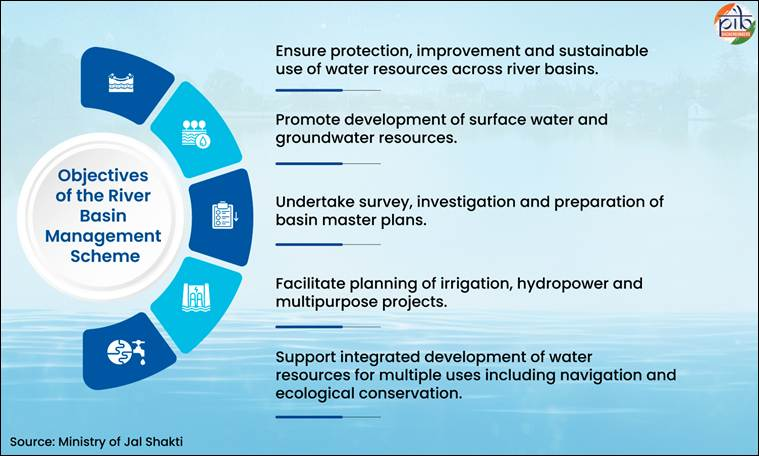
- The RBM Scheme is a Central Sector initiative under the Ministry of Jal Shakti designed to shift India’s water governance from fragmented, project-level interventions to a holistic, basin-level approach.
- Rather than treating rivers, tributaries, lakes, and groundwater in isolation, the scheme recognises an entire river basin as a single interconnected hydrological unit.
- A river basin is the total land area drained by a river and all its tributaries, recognised as India’s fundamental hydrological planning unit. Key components include the watershed (boundary separating basins), confluence (where rivers meet), and mouth (where the river drains into a sea or ocean).
Institutional Architecture
- The scheme operates through three specialised bodies with distinct, non-overlapping mandates:
- Brahmaputra Board: Dedicated exclusively to the North Eastern Region — handles river basin planning, flood control, erosion management, and drainage development for the Brahmaputra and Barak systems.
- Central Water Commission (CWC): Conducts hydrological surveys and prepares Detailed Project Reports (DPRs) for multipurpose water resource projects in remote and difficult terrains including J&K and Ladakh.
- National Water Development Agency (NWDA): Leads the Interlinking of Rivers (ILR) programme at the national level — preparing feasibility reports and DPRs for inter-basin water transfer projects.
Why Does This Scheme Matters?
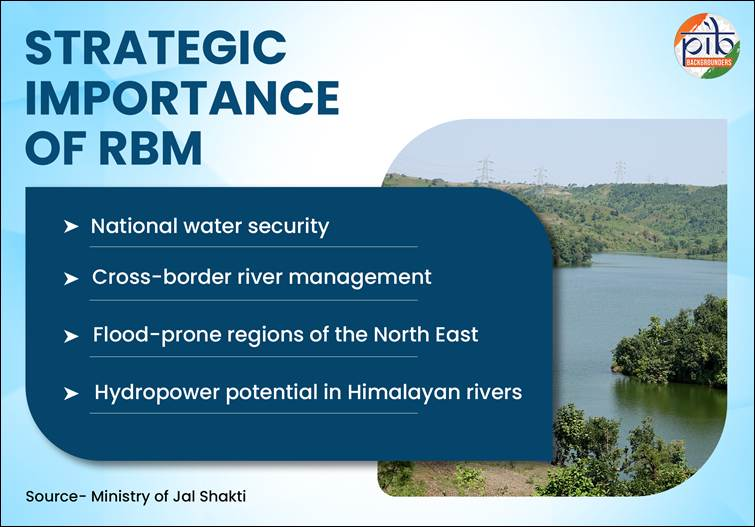
- Cross-Border Water Diplomacy: The Indus (shared with Pakistan) and Brahmaputra (shared with China and Bangladesh) are among the world’s most geopolitically sensitive rivers. Real-time basin-level data provides India with data sovereignty and negotiating leverage in transboundary water treaties and disputes.
- Climate Resilience: Erratic monsoons, glacial lake outburst floods (GLOFs), and prolonged droughts are intensifying. Basin-level infrastructure rather than isolated project responses is the only framework capable of building systemic climate resilience.
- Inter-State Water Equity: With 81% of India’s geographical area falling under inter-state basins, coordinated basin-level governance is essential to prevent unilateral upstream actions and ensure equitable downstream water access.
- Hydropower and Irrigation Unlocking: DPR preparation for Himalayan river projects opens significant untapped hydropower capacity and irrigation potential in the Northeast and J&K regions where energy and water deficits directly constrain economic growth.
Challenges
- Terrain and Logistics: Projects in J&K, Ladakh, and the Northeast face extremely short working seasons typically four to six months combined with poor connectivity, inflating costs and delaying timelines substantially.
- Inter-State Disputes: The absence of a binding national water allocation framework means river water sharing generates persistent legal and political friction directly complicating Interlinking of Rivers (ILR) implementation and Detailed Project Report (DPR) approvals.
- Real-Time Data Gaps: Historically weak streamflow monitoring networks have led to inaccurate hydrological predictions including runoff deficits in years with adequate snowpack. Bridging this data gap is foundational to the scheme’s success.
- Ecological Trade-offs: Large infrastructure like dams and barrages alters sediment flows, disrupts aquatic biodiversity, and affects downstream communities. Current project appraisal frameworks inadequately capture these cumulative ecological costs.
- Cost Escalation: Anti-erosion works in dynamic, laterally shifting rivers like the Brahmaputra regularly exceed initial budget estimates reflecting the inherent unpredictability of managing one of the world’s most powerful river systems.
Way Ahead
- Scaling LiDAR and drone surveys across all priority basins will generate high-resolution digital elevation models.
- NEHARI (North East Hydraulic and Allied Research Institute) must be strengthened to build state-level technical capacity in the Northeast.
- Institutionalising mandatory environmental flow assessments within DPR appraisal protocols will help balance infrastructure development with ecological protection.
- A national water framework law was long recommended but not enacted that would resolve inter-state allocation disputes and provide a stable legal foundation for ILR implementation.
Source: PIB
Previous article
India–Sri Lanka Relations: India’s VP’s Visit
Next article
Gene Drives Transforming Malaria Control
